On the impedance mismatch between agile and classical business management
This post was created with AI assistance and follows the Kladde 26 manifesto.
Kladde 26 is a manifesto for transparency in AI-assisted writing; it asks writers to show their workings. The frequently asked questions provide the background.
I have long tried to understand why management insists on fixed time, fixed cost, and fixed scope when planning software development projects. This article is my attempt to explain why this pattern occurs, and what organizational change may be able to fix it.
While I was experimenting with some audio equipment, it came to me that what we call an impedance mismatch in electrical engineering is actually a common problem in software development, too. Perhaps we can learn about the solution from a domain that has this problem solved?
Whenever two systems speak different languages, connecting them requires more than a simple cable. Without a proper adapter, energy dissipates as heat, signals distort, and eventually something burns out. Engineers have a precise term for this: impedance mismatch. It describes what happens when the internal resistance of a source does not match the load it drives.
This concept is not limited to physics. The same pattern appears in software architecture, and most critically in the relationship between agile development and classical business management. Understanding the pattern across all three domains makes it easier to see why the organizational version is so destructive, and what kind of "transformer" is needed to fix it.
Amplifiers and Speakers
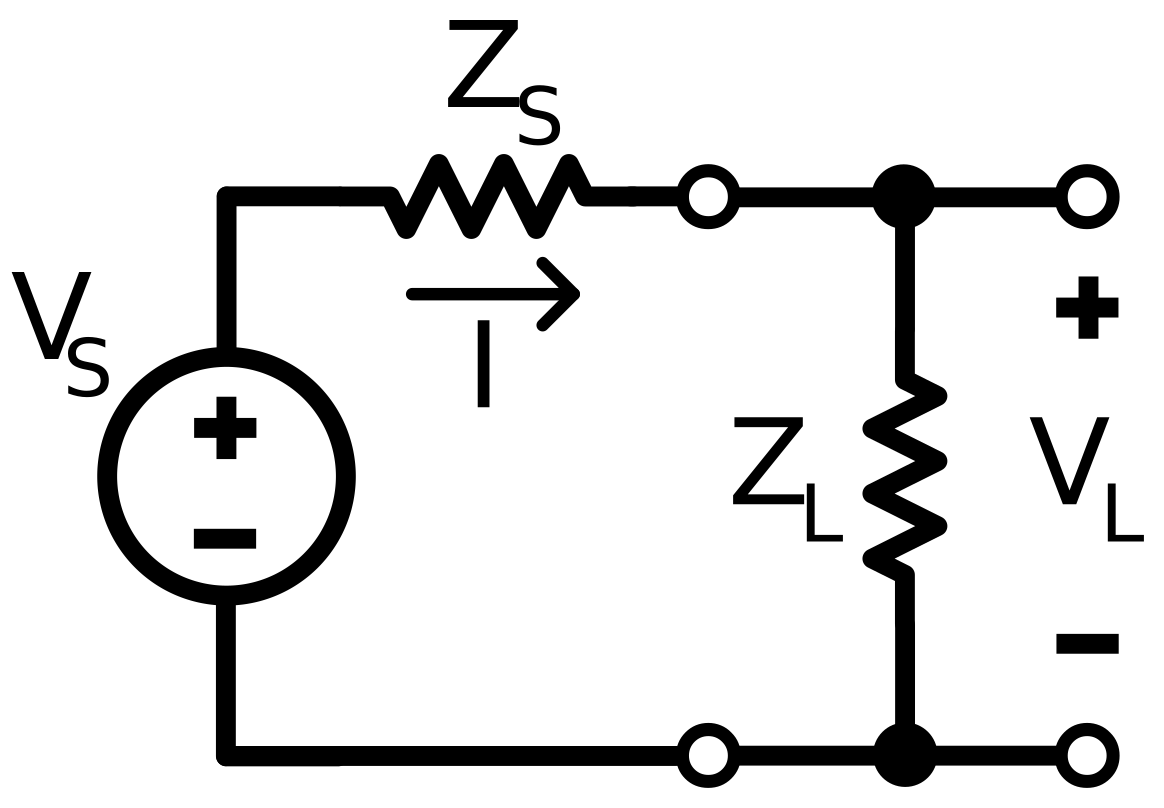
In audio engineering, an amplifier is designed for a specific load impedance, typically 8 ohms. Connect a 4-ohm speaker, and the resistance drops by half. Ohm's law dictates that the current doubles. The amplifier's output stage is now pushed beyond its specification.
.svg)
The symptoms are immediate and physical:
- Overheating. The transistors must carry more current than they were built for, generating excess thermal load. If the heat sinks cannot dissipate it, the device fails.
- Clipping. When the amplifier can no longer reproduce the signal cleanly, it cuts off the waveform peaks. The resulting distortion contains DC components that can destroy the speaker's tweeters.
- Power-supply collapse. The transformer and capacitors may not deliver the doubled demand, causing voltage sag or blown fuses.
Yelling at the amplifier does not help. You have to match the impedances, either by selecting the right speaker, or by inserting a transformer that adapts the load to the source.
Object-Relational Mappers
Software engineers use the exact same term, impedance mismatch, to describe the friction between object-oriented programs and relational databases. Object-oriented design thinks in graphs: nested structures, inheritance, encapsulation, and behavior. Relational design thinks in flat tables, foreign keys, and normalized rows. They are fundamentally different logics.

An Object-Relational Mapper (ORM) like Hibernate or Entity Framework is the adapter placed between these worlds. It translates objects into rows and back again. And if the mapping is naive or ignored, the system pays the price:
- Performance loss (heat). A poorly configured ORM can issue hundreds of queries for a single logical operation, the infamous N+1 problem. The database CPU burns cycles on translation instead of on actual work.
- Abstraction leakage. When the relational reality "leaks" into the application code, developers lose the very transparency the ORM was supposed to provide.
- Complexity debt. The convenience of automatic mapping often hides what the database is really doing, making optimization impossible until the system chokes.
No skilled engineer blames the database for being relational, or the code for being object-oriented. The mapping layer is designed carefully, because the mismatch is real, and ignoring it will eventually degrade the whole system.
Agile Development vs. Deterministic Management
The same mismatch reappears when classical business management meets agile software development. Only here, the consequences are human rather than thermal.
Management often operates from a deterministic paradigm: fixed budget, fixed deadline, fixed scope. This mindset works well for repeatable, well-understood endeavors like building a bridge or manufacturing a batch of parts. But software development is not manufacturing; it is empirical learning. Most of the time, the team is solving a complex problem for the first time. The path is unknown, and the map must be drawn while walking.
When deterministic expectations are connected directly to an empirical process, the organizational equivalent of an impedance mismatch occurs:
- Thermal load (burnout). The pressure on the team rises linearly with the unpredictability of the work. People compensate with overtime, and the friction between management and engineering generates heat in the form of conflict and attrition.
- Clipping (technical debt). To meet fixed deadlines with fixed scope, quality is sacrificed. The "signal" (the codebase) becomes distorted. Shortcuts accumulate, and eventually the system becomes unstable, just as a clipped signal destroys a tweeter.
- Scrum theater (cheap adapter). A team may adopt the rituals of agility (daily standups, sprints, retrospectives) while still being managed to a rigid Gantt chart. This is the organizational equivalent of a cheap adapter that pretends to transform the signal but merely passes the overload through.
The Transformer
In electrical engineering, the mismatch is often solved with a transformer. In software architecture, it is solved by a carefully designed ORM. In the organization, the transformer is the Product Owner (and, by extension, an agile coach or engineering leader).
The product owner's job is not just collecting requirements and prioritizing tickets. It is regulating: translating between incompatible paradigms and protecting the system from overload.
This means telling the truth upward: fixed planning parameters in an uncertain environment are not a sign of discipline; they are a short-circuit waiting to happen. When time and cost are fixed, scope must remain variable, or quality will collapse. The product owner must make this physical reality visible to management, using the same clarity an engineer uses when explaining why a 4-ohm speaker will destroy an 8-ohm amplifier.
Practical Techniques
How does a product owner actually perform this translation? Here is what works:
-
Visualize the iron triangle. Show that time, cost, and scope are rigidly coupled. Lock all three, and quality (the central pillar) implodes. A simple diagram is often more effective than a thousand project reports.
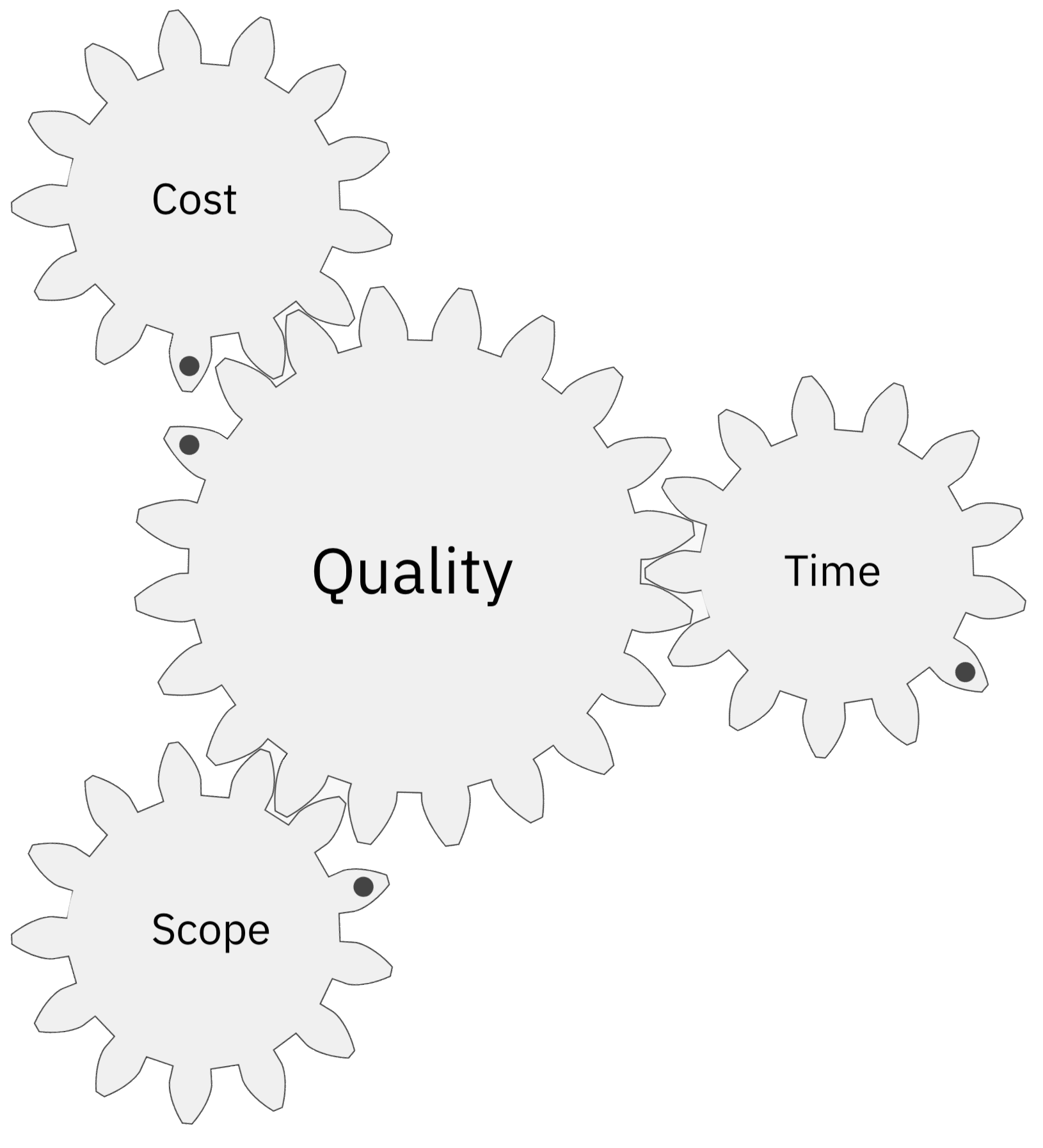
Fixing Time, Cost, and Scope forces Quality to absorb all the pressure. -
Use evidence, not opinion. Track velocity and cycle time. If the system demonstrably delivers twenty units per sprint, demanding forty will not double output; it will only double defects. Numbers remove emotion from the conversation.
-
Replace dates with horizons. Instead of Gantt charts promising delivery on a specific day, use roadmaps organized as Now, Next, and Later. This gives leadership strategic orientation without forcing the team to commit to a cadence it cannot sustain.
-
Negotiate outcomes, not outputs. Promise the solution of a business problem, not a fixed list of features. This satisfies management's need for return on investment while preserving the team's freedom to discover the best technical path.
-
Protect the Definition of Done. Treat it as non-negotiable infrastructure, like the insulation on a high-voltage cable. It exists to prevent technical debt from accumulating silently until the system fails.
Whether in an audio circuit, a database layer, or an organization, an impedance mismatch signals the same thing: two subsystems with incompatible parameters have been connected without a proper adapter. The result is always loss: of energy, of performance, or of people.
The required adaptation is structural, not a matter of preference or culture. Just as a transformer is not optional when impedances differ, a mediating role between deterministic management and empirical development is not optional when the goal is sustainable delivery. Control through fixed plans is an illusion in complex domains; what remains is control through visibility, feedback, and continuous adjustment.
Match the impedances, and the energy of the organization flows into the product instead of burning people out.